
When “Wait and See” Isn’t Enough
A conversation with a policy expert on early reading, national declines, and what parents can do now.

This week, an excellent guest joined us for the 10th(!) episode of The Reading Symphony Podcast!

Back in October, education analyst Chad Aldeman published a Substack post titled “Do. Not. Wait.” At first glance, the title might sound like hyperbolic clickbait, but I promise you it is not. It is practical advice. As the name suggests, “Do. Not. Wait.” argues for shifting from a “wait and see” mindset to a “check and see” stance when it comes to children’s reading progress.
Why?
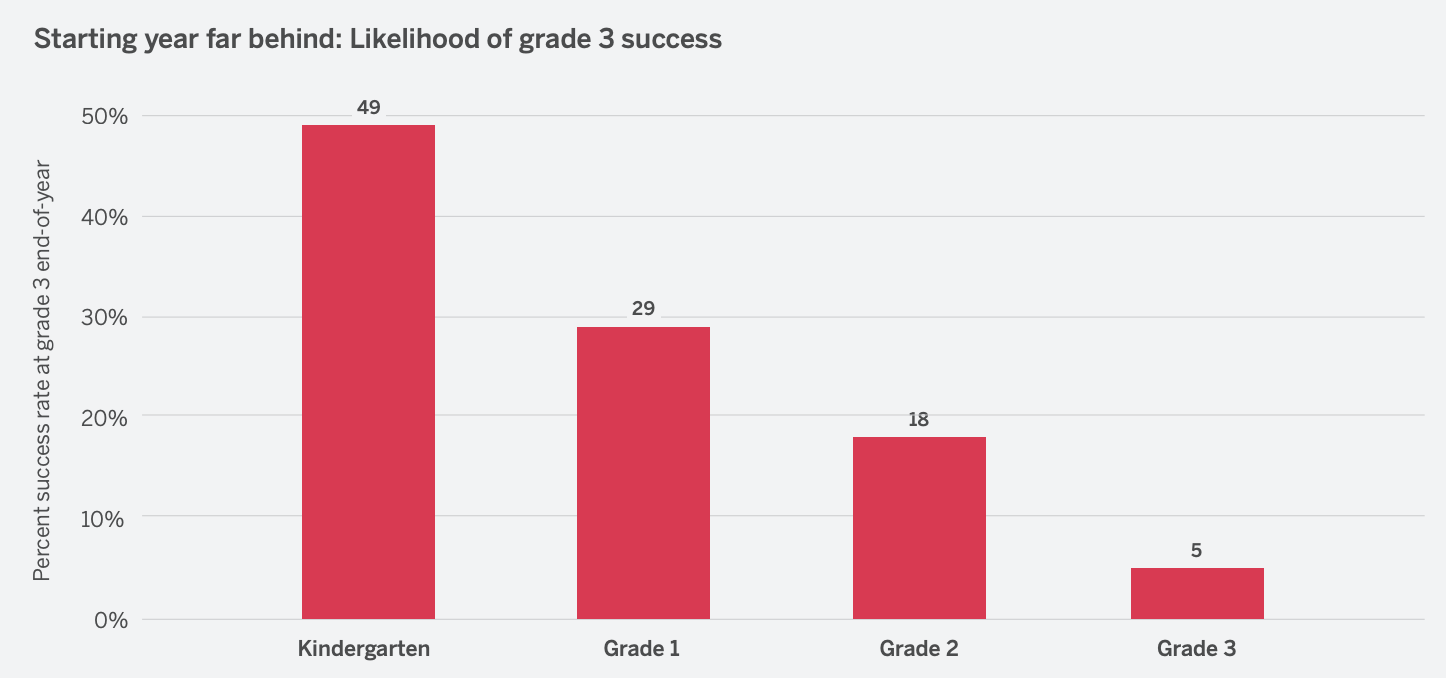
Consider this graph that Chad sourced from Amplify, the maker of the widely used DIBELS assessment. The data represent approximately 250,000 students across 1,400 schools in 43 states.
Here is how Chad explained the data:
“Among kindergartners who started the 2021–22 school year off track, 49% were on track by the end of third grade. That’s basically a coin toss.
Among first graders who started the 2022–23 school year behind, just 29% ended third grade on track.
Among second graders who started the 2023–24 school year off track, only 18% completed third grade on track.
Among third graders who started the 2024–25 school year behind, just 5% were on track by the end of the year.”
Five. Percent.
When the gravity of this reality first registered in my brain, I immediately thought of a powerful quote from dyslexia researcher Dr. Maryanne Wolf. In her 2011 article, “Dear Parent: Why Your Dyslexic Child Struggles with Reading,” she wrote:
“I am an educator and neuroscientist who studies how the brain learns to read and what happens when a young brain can’t learn to read easily… Yet, despite this knowledge, I was unprepared to realize that my first son was dyslexic… I wept not because of his dyslexia, which I understood very well, but because I knew the long, difficult road he faced in an educational system ill-prepared to meet his needs.”
When I opened my own daughter’s reading report last year and saw that she was well below where she needed to be, I wept too. My tears had nothing to do with disappointment or embarrassment about my daughter’s struggles. They had everything to do with what I know to be true about schools. I understand that most teachers are deeply committed and hardworking. I also understand that many were never properly trained to teach reading; I know that preparation programs vary widely in quality; I know that curriculum adoption measures are often poorly implemented; and, most importantly, I know that children can move quickly from “a little behind” to “forever behind.”
My daughter has been fortunate to have strong teachers so far. Yet, I also know that strong instruction is not guaranteed year after year in most systems.
Read Not Guess: how a policy expert became a parent advocate
Chad’s son was in kindergarten in 2020. When COVID shut down schools and virtual learning began, he believed his son already knew how to read. Then one day, Chad noticed this:
“When he would come to a word he didn’t recognize, and instead of looking at the word, he would look up to the ceiling and think about what the word might be.”
His son had not been taught to decode. What followed was a year-long effort to backfill foundational reading skills. That experience led Chad to ask a larger question:
“If I’m a parent and I work in education policy, and even I didn’t catch it, what else could I offer for other parents?”
That question evolved into Read Not Guess, a free, sequential, parent-facing reading program designed to help families build real decoding skills. It began as a simple summer program focused on early basics. The first summer, Chad shared, it reached about 1,100 users. He continued building from there. Today, Read Not Guess includes:
Levels 1, 2, and 3 with structured, sequential decoding lessons
A “daily-ish decodable” program for older students who need additional practice
A predictable lesson format that reinforces sound work, blending, word reading, and connected text
An optional app that provides audio support
Chad acknowledged that many parent resources exist, but some remain too general to be useful, and others are so technical that parents feel unprepared to use them. His goal was simplicity and accessibility. As a parent and a reading specialist, I second that description. Read Not Guess provides manageable, effective practice without overwhelming families. It supports consistent attention to foundational skills in small, sustainable increments.
Zooming out: national declines and why the bottom is falling out.
After discussing “Do. Not. Wait.” And Read Not Guess, we widened the lens to larger-scale achievement trends. I’ve written about the decline in NAEP scores a few times already, but here’s a refresher: only about a third of 4th and 8th-graders earned a proficient score on the test. Only two-thirds of 12th graders did. The reality is that most kids, very possibly including yours, are not reading at the level of proficiency they should be.
Many people attribute declines in reading and math performance to COVID, but Chad, who helped write education reform during the Obama administration, noted that the downturn began earlier. Across multiple assessments and subjects, achievement peaked roughly a decade ago.
He went on to explain that the decline is not evenly distributed. The most dramatic drops appear among students who were already struggling. He also made the important point that the declines affected all subgroups, including children across all different races, socioeconomic strata, disability status, and levels of English language proficiency. In other words, all of our struggling students are struggling more than they were ten years ago.
Chad outlined several contributing factors that align with both timing and trajectory:
Changes in accountability policy, beginning with federal waivers in 2011 and continuing under ESSA in 2015. This is a complicated one to explain, but essentially the No Child Left Behind Act of the early 2000s went HARD on proficiency across ALL student subgroups but did not account for growth, resulting in overly punitive measures for districts that had low proficiency but high growth. Then, in 2015, the Obama administration softened its approach with the passage of the Every Student Succeeds Act (ESSA). That move deserves its own post, which, luckily, Chad has written! Check it out here. In short, Chad recommends using growth as a measure of success. I do too, and the cool thing is that this is a way to push studetns at all levels, from the lowest performing to the highest performing (who often make little growth because they are assumed to be fine).
Increased screen exposure at home and at school
Declines in voluntary reading as digital entertainment expands
Reduced emphasis on foundational skills while prioritizing higher-order tasks
He also addressed a common assumption that content knowledge is less important in an era of search engines and artificial intelligence. The good news is that improvement remains possible. Chad pointed to states such as Mississippi and Louisiana, as well as international examples like England, where greater attention to foundational instruction, knowledge building, and coherent systems has produced measurable gains.
Staffing, teacher pay, and the structure of spending
We then turned to staffing, funding, and compensation, where Chad offered some surprising insights. Schools today employ more staff than in previous decades, including more staff per student. Yet teacher pay has not increased at the same rate as overall education spending.
He identified two significant drivers:
Rising pension and benefit costs
Expansion of staffing in non-teaching roles such as specialists, paraprofessionals, coaches, and administrative positions
The issue is not whether these roles matter, but that budgets involve trade-offs. Expanding staffing across multiple categories constrains the ability to significantly raise teacher salaries.
Chad also described models attempting to address this tension:
Team-based teaching structures that create differentiated roles and leadership pay
Incentives for hard-to-staff roles and schools to reduce churn
Strategic redesign of staffing models to protect instruction while allocating more resources toward compensation
He emphasized, and I agree, that many current structures are the result of choices.
Chad’s advice to parents: look for clarity, act early
At the end of our conversation, I asked Chad what parents should do. First, he started with the reality that districts operate like large ships that move slowly. So families can advocate for change. They can explore different school options if those are available. They can identify strong adults within schools, churches, or their community who combine high expectations with high support. But he also returned to his initial warning:
Essentially, if you see your child struggling, don’t wait... Don’t assume that the school is going to take care of it. You do need to take some steps either to work directly with your teacher, or maybe if you have other school options available, you should look into them. Find other ways to get adults into your child’s life that are taking care of them. Could be after school, it could be sports, could be church, whatever that might be for your particular situation.”
We now understand that the probability of catching up declines without timely, intensive support. This is why we CAN.NOT.WAIT.
If today’s post resonated, you’ll love the full conversation with Chad. You can listen to the full episode of The Reading Symphony Podcast wherever you get your podcasts. And if you’re new here, you can subscribe to my free weekly newsletter at katiemegrian.substack.com for practical, research-aligned tools to help your child become a skilled, joyful reader. Most importantly, if you feel your child is struggling and you want further clarity, please don’t hesitate to reach out to me at katie@thereadingsymphony.com.