
Why Learning to Read is So Hard
Understanding the Hidden Complexity Behind a Skill That Feels Natural — and How We Can Better Support Our Young Readers

Dear Raising Readers Community,
Today, I’m zooming WAY out to give a broad overview of how reading works — and why it can be so challenging. I won’t dive into how children learn to read specific words just yet (future posts will get into the nitty-gritty!). My goal today is to simply explain why reading is such a complex process.
And as I always will, I’m starting with a story about one of my little readers at home.
If your life as a parent looks anything like mine, your children have interrupted your blissful — and already limited — sleep roughly a thousand times since their birth. It’s part of the beautiful chaos of parenthood, I know, but every time my kids crash into my bedroom door — consistently forgetting to TURN. THE. KNOB. FIRST. — I usually do not react kindly.
But last week, something special happened. At 5 a.m., E, my oldest, barreled in, snuggled right up to my face, and asked a question that could melt any reading teacher’s heart:
“Mama, how come the word ‘no’ isn’t spelled with a sneaky e?”
I sat up immediately, teaching mode activated.
“That’s a great question, E! The word ‘no’ is an open syllable. Do you remember what open syllables usually do?”
“They make a long vowel sound!” she proudly replied.
“Yes!” I affirmed. “You’re right — and I love how you’re thinking about words first thing in the morning!” (For context, she’s been studying VCe words — like ‘cake’ and ‘time’ — in class, where a silent ‘e’ makes the vowel long.)
E made her thinking face, paused, and then asked: “But what about the word ‘to’? Shouldn’t it sound like ‘toe’ if it’s an open syllable too?”
Well, damn.
Reading is hard — especially in English, where it often feels like there’s a rule-breaker for every rule. E’s question made me think of this hilarious— and painfully accurate —video that reading teachers often share.
Here’s the thing: if you’re reading this post, the act of reading feels automatic and natural to you. But from an evolutionary perspective, reading is neither automatic nor natural. Humans began evolving about 2.5 million years ago. The first evidence of human writing didn’t emerge until around 5,000 years ago — just a blink of an eye in evolutionary terms.1 While we are biologically wired to speak and listen, we are not wired to read. Reading must be taught systematically and practiced over time. But to know how to support young readers, we need to first understand how the process works.
Two Big Models of How Reading Works
In education, two popular models illustrate how reading happens. Important disclaimer: no model can capture the full, messy, overlapping reality of reading. Reading is not a simple first-you-do-this-then-you-do-that process. Everything overlaps, reinforces, and builds simultaneously. Still, models can help us understand the major skills readers need to coordinate.
1. The Simple View of Reading
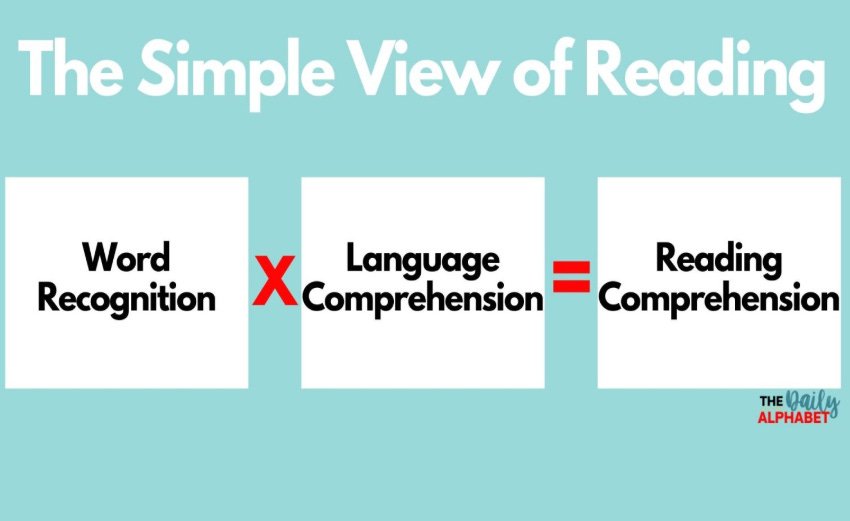
This model2 shows that reading comprehension (understanding what you read) comes from two major factors:
Word Recognition (being able to read the words)
Language Comprehension (understanding what the words mean)
If either factor is weak — less than 100%, so to speak — then reading comprehension will also be weak. It’s simple yet deceptively deep.
2. Scarborough’s Reading Rope
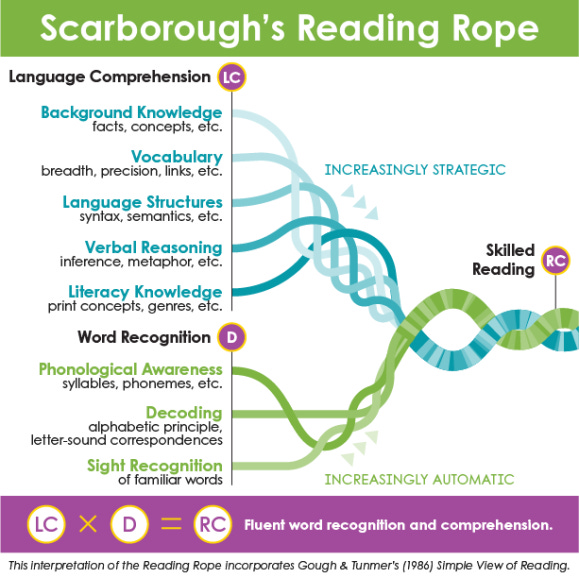
The Reading Rope3 extends the Simple View into a more detailed and vivid metaphor. Think of it as showing the many strands that must weave together to create a skilled, fluent reader. Here’s a quick breakdown:
Word Recognition:
Phonological Awareness: Recognizing syllables, rhymes, and individual sounds in words.
Decoding: Matching letters (or groups of letters) to sounds.
Sight Recognition: Instantly recognizing familiar words (even the weird ones, like “to” and “no”).
As decoding and word recognition become more automatic, kids can and should also learn to build their language comprehension skills.
Language Comprehension:
Background Knowledge: The more students know about the world, the more they understand new reading material.
Vocabulary: Knowing more words makes reading smoother and faster.
Language Structures: Understanding grammar, syntax (how sentences are built), and punctuation. (For instance, connecting pronouns to the right antecedents, noticing how commas change meaning, etc.)
Verbal Reasoning: Knowing when a writer is being literal versus figurative — requires strong background knowledge and language awareness.
Literacy Knowledge: Recognizing text structures and genres. (For example, when I read a novel, I look for themes. When I read an article, I search for the main idea.)
Over time, word recognition skills become more automatic while language comprehension skills become increasingly strategic.
Why This Matters
When we realize that reading requires all of these skills to work together — simultaneously — it’s no wonder it can feel so hard to learn.
The good news? Once we understand the complexity, we can better support our children. Future posts will break down each strand of the rope and share practical tips for helping your young readers.
You’re doing amazing work by being here and learning with me. Thank you for being part of this community!
Until next time,
Katie
Harari, Y. N., Vandermeulen, D., & Casanave, D. (2020). Sapiens: A graphic history, volume 1: The birth of humankind. Harper.
image sourced from thedailyalphabet.com
image sourced from reallygreatreading.com